


Medications such as Ozempic (semaglutide), Wegovy and Mounjaro (tirzepatide) can be a life-changing option for many people living with type 2 diabetes or managing their weight. However, some users report new or worsening gut symptoms such as nausea, vomiting and slowed digestion after starting treatment. In this blog, we delve into the scientific literature to explain how GLP-1 medicines work, how they affect gut function and practical steps to take if you suspect gut problems.

What is GLP-1?
GLP-1 medications contain synthetic substances called glucagon-like peptide-1 receptor agonists (GLP-1 RAs), which mimic the natural GLP-1 hormone. This hormone tells the body to release insulin when blood glucose (sugar) levels rise and suppresses more glucose from being released into the blood. It helps us feel full for longer and slows down the process of moving food from the stomach into the intestines, which is known as gastric emptying (1).
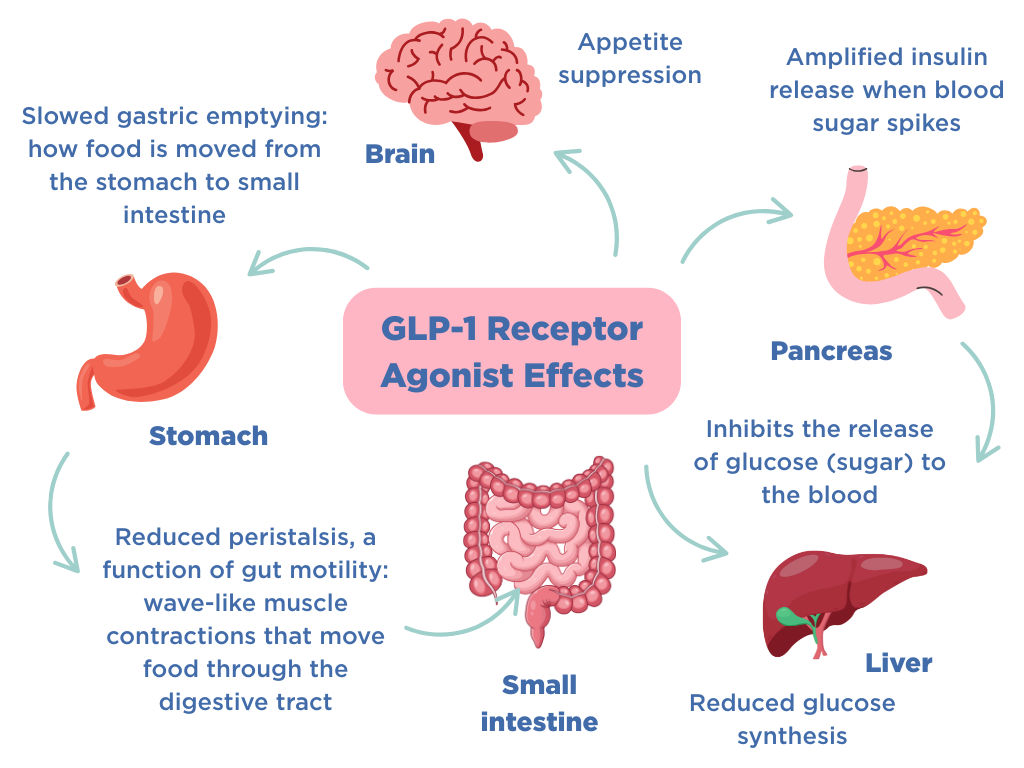
How does GLP-1 medication affect the gut?
Around 40-50% of GLP-1 users report nausea or bloating in the early stages of treatment, though symptoms should settle in the first 4-8 weeks as the body adapts (2). While mild, fleeting gut symptoms are normal, some rarer cases involve symptoms that don’t go away. These could point to an underlying gut issue called small intestinal bacterial overgrowth (SIBO). For example, one case study reported worsened lactose intolerance and new gluten intolerance following semaglutide treatment for weight loss. Even after stopping the weight loss medications, symptoms persisted, and they were later diagnosed with SIBO (3).
Because GLP-1 medications slow digestion, researchers have asked whether they might contribute to SIBO or similar less common conditions such as intestinal methanogen overgrowth (IMO). It is important to keep in mind that people taking GLP-1 medications may already be at risk of developing SIBO for other reasons. For example, using anti-acid medications or opioids puts you at risk. Some people may also be genetically pre-disposed or have a sensitive gut to begin with.

What is SIBO?
SIBO occurs when too many bacteria settle in the small intestine. The small intestine is normally a relatively hostile environment for bacteria. The body produces antimicrobial substances such as bile and mucus, as well as has specialised immune cells in the intestinal wall. The fast flow of food further helps to wash away bacteria before they get a chance to stick around.
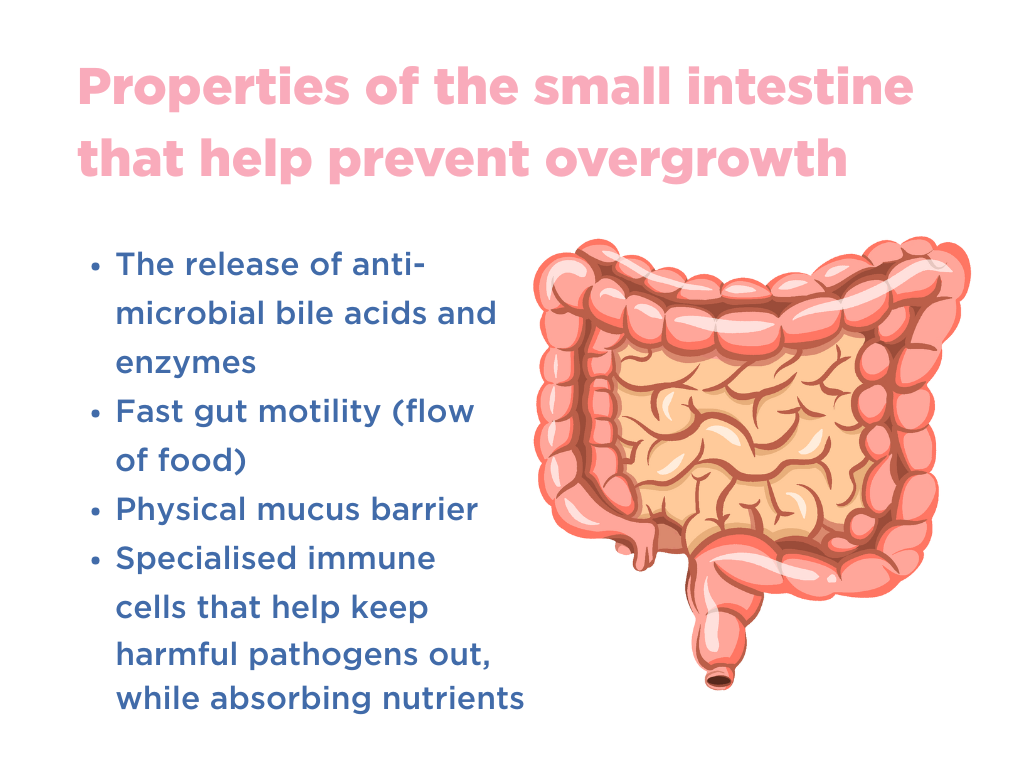
SIBO can occur for several reasons, impaired gut motility, structural changes in the gut, or other underlying conditions (e.g., diabetes, obesity immune health issues or old age). Since GLP-1 medications are known to reduce gut motility, scientists have wondered whether they could play a role in causing SIBO or IMO. In theory, slowed digestion could give bacteria more time to multiply in the small intestine, as this can occur in long-standing diabetes, where nerve damage can disrupt gut function (4).
SIBO and IMO can be diagnosed using a simple breath test. If you are experiencing any of the bloating, gas, changes in bowel habits, sudden urges to go to the toilet, uncontrolled weight loss or fatigue always seek advice from a trusted healthcare professional.
What the research shows
To explore whether GLP-1 medications are associated with increased risk of gastrointestinal conditions, a recent study compared over 200,000 individuals taking GLP-1 medications with a group taking other type 2 diabetes medications (1). People who had a high risk of SIBO from different sources, such as major abdominal surgery or slowed gut motility, were excluded from the study. They found a statistical increase in the number of SIBO diagnoses between patients on GLP-1 Ras (medications) compared to those not using them. Despite showing an increase in SIBO likelihood, the numbers were minimal (fewer than 0.02%), and the study did not prove causation, only a correlation based on a yes/no diagnosis.
For context, 10-15% of the general population tests positive for SIBO or IMO. Other research highlights:
- 30% of GLP-1 users tested positive for SIBO or IMO even after accounting for diabetes (5)
- GLP-1 medicines caused microbiome changes and altered metabolism in mice (6)
- GLP-1 medicines tested in humans only had noticeable microbiome changes by 48 weeks (7)
- Despite not necessarily having slower gut motility, one study found that 88.9% of obese patients had SIBO (8)
- A meta analysis of people with IBS symptoms, found that up to 78% of people had SIBO, many of whom were undiagnosed (9)
Overall, Sun and colleagues (1) could not prove a mechanistic link between GLP-1 medications and SIBO, however they did find that SIBO was twice as likely in GLP-1 users. The incidence rate was however very small, meaning that any direct causality is hard to pin down. To explain these findings, we must consider the power of detection bias. People taking GLP-1 may be more likely to be tested for SIBO. Because SIBO testing is uncommon in the general population, increased testing among GLP-1 users can make it appear that cases are rising, when in reality we are simply increasing testing and therefore finding more cases. This may highlight a broader issue of under-testing and under-diagnosing SIBO. At OMED Health, we believe that SIBO testing is the first step towards taking control of your gut health.
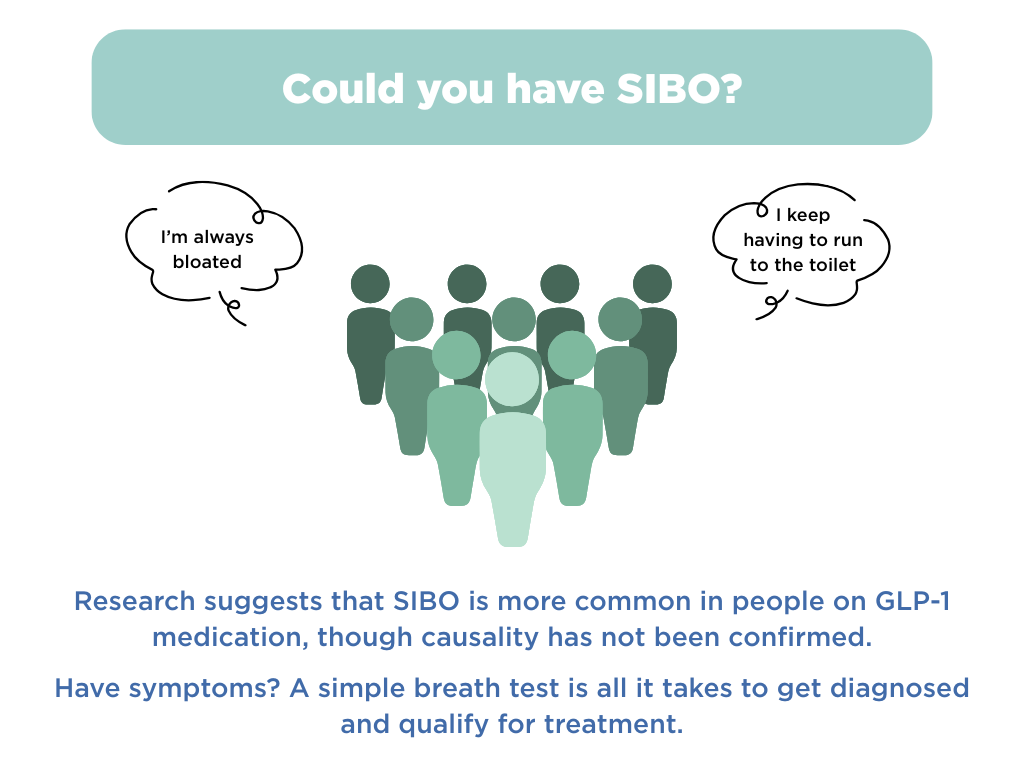
What to do if you have persistent gut symptoms
Experiencing bloating, cramps, fatigue, nausea and unpredictable digestion are signs that your gut isn’t functioning as it should. Our simple solution breath testing solution allows you to uncover what’s driving your gut symptoms.
A simple at-home SIBO breath test measures the hydrogen and methane produced by your gut microbiome. This test is carried out using the OMED Health Breath Analyzer. This is a registered medical device that provides accurate readings of your gas levels, allowing an OMED Health doctor to provide a diagnosis of SIBO and IMO. If you test positive, your healthcare provider can recommend a personalized treatment plan based on your diagnosis. Ask your healthcare provider about a SIBO Test to find the root cause of your symptoms.

References:
- Sun Y, Veccia D, Liu BDX, Tse W, Fass R, Song G. Diagnostic Evaluation of an Increased Risk of Developing Small Intestinal Bacterial Overgrowth Associated with Glucagon-like Peptide-1 (GLP-1) Receptor Agonists and Dual GLP-1/GIP Receptor Agonists: A Global Retrospective Multicenter Cohort Analysis. Diagnostics (Basel). 2025 Sept 7;15(17):2264. doi: 10.3390/diagnostics15172264
- Masulli M, Tack J, Esposito G, Sarnelli G. GLP-1 and GIP agonists in diabetes and obesity and the rise of dyspepsia. Intern Emerg Med [Internet]. 2025 Sept 21 [cited 2025 Oct 21]; Available from: https://doi.org/10.1007/s11739-025-04117-9
- Carris NW, Wallace S, DuCoin CG, Mhaskar R, Stern M, Bunnell B. Discontinuing semaglutide after weight loss: strategy for weight maintenance and a possible new side effect. Can J Physiol Pharmacol. 2024 June;102(6):391–5. doi: 10.1139/cjpp-2023-0464
- Kuźnik E, Dudkowiak R, Adamiec R, Poniewierka E. Diabetic autonomic neuropathy of the gastrointestinal tract. Gastroenterology Rev. 2020;15(2):89–93. doi: 10.5114/pg.2020.95554
- Damianos JA, Fredrick TW, Jin MF, Ospina-Velasquez L, Wang XJ. GLP-1 Receptor Agonist Use Is Associated with Small Intestinal Bacterial Overgrowth and Intestinal Methanogen Overgrowth. Foregut. 2025 July 8;26345161251353437. doi: 10.1177/26345161251353437
- Kato S, Sato T, Fujita H, Kawatani M, Yamada Y. Effects of GLP-1 receptor agonist on changes in the gut bacterium and the underlying mechanisms. Sci Rep. 2021 Apr 28;11:9167. doi: 10.1038/s41598-021-88612-x
- Liang L, Su X, Guan Y, Wu B, Zhang X, Nian X. Correlation between intestinal flora and GLP-1 receptor agonist dulaglutide in type 2 diabetes mellitus treatment—A preliminary longitudinal study. iScience [Internet]. 2024 May 17 [cited 2025 Oct 21];27(5). doi: 10.1016/j.isci.2024.109784
- Roland BC, Lee D, Miller LS, Vegesna A, Yolken R, Severance E, et al. Obesity increases the risk of small intestinal bacterial overgrowth (SIBO). Neurogastroenterol Motil. 2018 Mar;30(3). doi: 10.1111/nmo.13199
- Ghoshal UC, Shukla R, Ghoshal U. Small Intestinal Bacterial Overgrowth and Irritable Bowel Syndrome: A Bridge between Functional Organic Dichotomy. Gut Liver. 2017 Mar;11(2):196–208. doi: 10.5009/gnl16126

Common Questions
Can GLP1 medications like Ozempic or Mounjaro cause SIBO?
The short answer is no. So far, we do not have definitive evidence to show that taking GLP1 causes small intestinal bacterial overgrowth (SIBO). However, there is an increasing number of studies demonstrating strong associations between poor gut health (including having SIBO) and taking GLP1. A likely mechanism behind this connection is the fact that GLP1 slows gut motility, which is a major cause of SIBO.
Why is slow gut motility linked to SIBO?
Slower movement of food through the small intestine allows bacteria to linger and multiply. This can lead to an overgrowth. You can learn more about the symptoms, causes and treatments for SIBO in our free SIBO eBook.
Our FAQ section might not have the answer you’re looking for right now but our team certainly will. If you need answers, contact us